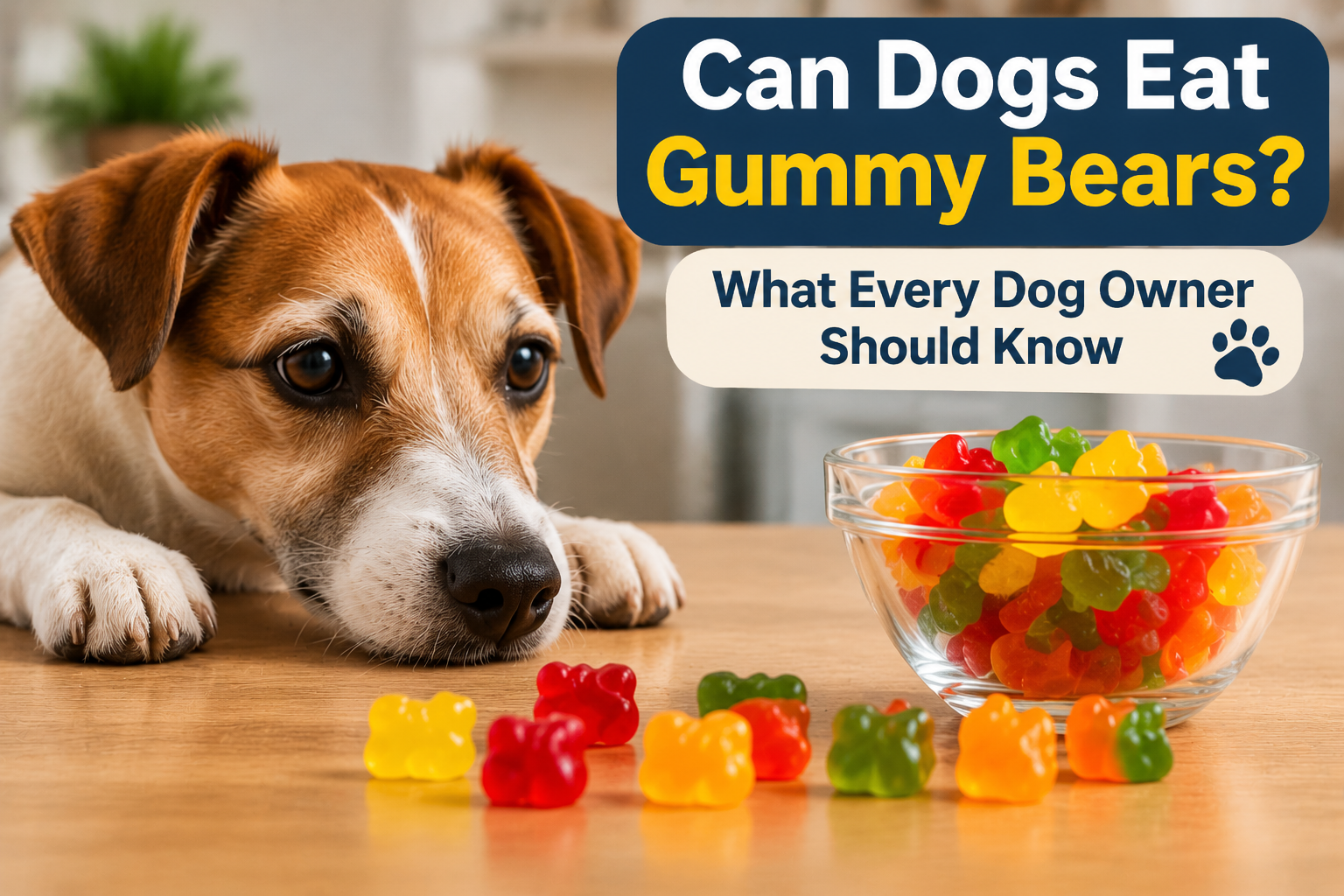
You leave a packet of gummy bears on the coffee table for just a moment. When you return, your dog is happily licking their lips, and several colorful candies have disappeared.
Your first question is probably simple: Can dogs eat gummy bears, or should you be worried?
The answer depends on the type of gummy bears your dog ate.
Regular gummy bears made with sugar are not generally considered highly toxic to dogs in small amounts. However, they offer no meaningful nutritional benefits and can cause digestive upset. Sugar-free gummy bears are a much more serious concern because some contain xylitol, a sweetener that can cause dangerous drops in blood sugar and potentially severe liver damage in dogs.
There is also another important distinction: gummy vitamins, CBD gummies, and cannabis-infused edibles are not the same as ordinary candy. They may contain additional ingredients that pose serious health risks.
If your dog has already eaten gummy bears, do not assume they are safe simply because they look like ordinary candy.
In this guide, we explain whether dogs can eat gummy bears, which ingredients are dangerous, what symptoms to watch for, and exactly what to do if your dog gets into a packet of gummies.
Can Dogs Eat Gummy Bears?
No. Gummy bears are not a recommended treat for dogs.
Although a small amount of ordinary, sugar-based gummy candy may not cause serious poisoning in an otherwise healthy dog, that does not make it a suitable snack.
Traditional gummy bears generally contain ingredients such as:
- Sugar or corn syrup.
- Gelatin.
- Food coloring.
- Flavorings.
- Acids such as citric acid.
These ingredients provide little nutritional value for dogs. Eating too many gummy bears may lead to stomach discomfort, vomiting, diarrhea, or other digestive problems.
The bigger concern is that not all gummy bears have the same ingredients.
Some sugar-free candies contain xylitol, a sweetener that is highly toxic to dogs. Certain gummy products may also contain vitamins, supplements, medications, CBD, or THC.
Therefore, the safety of a gummy product depends on its exact ingredients, the amount consumed, and your dog’s size and health.
The safest choice is to keep gummy bears and other human candies out of your dog’s diet.
Why Are Gummy Bears Bad for Dogs?
There are several reasons why gummy bears should not be part of your dog’s regular diet.
1. High Sugar Content
Traditional gummy bears contain concentrated amounts of sugar.
Although sugar itself is not the same type of toxin as xylitol, consuming large quantities can upset your dog’s digestive system.
Possible problems include:
- Vomiting.
- Diarrhea.
- Gas and abdominal discomfort.
- Increased thirst.
- Unnecessary calorie consumption.
Regularly feeding sugary snacks can also contribute to unhealthy weight gain and dental problems.
Dogs already receive the energy they need from their complete and balanced food. They do not need sugary human candy.
2. Xylitol Can Be Extremely Toxic
This is the most important ingredient to look for when checking gummy candy.
Xylitol is a sugar substitute used in some sugar-free foods, candies, chewing gum, and other products.
While humans can safely consume xylitol in approved food products, dogs react very differently.
When a dog ingests xylitol, their body can release an excessive amount of insulin. This causes blood glucose levels to drop dangerously low, a condition known as hypoglycemia.
Depending on the amount consumed, xylitol poisoning can also cause serious liver injury or liver failure.
Warning signs may include:
- Vomiting.
- Weakness.
- Unusual tiredness.
- Difficulty walking.
- Loss of coordination.
- Trembling or shaking.
- Collapse.
- Seizures.
Signs can develop rapidly, and some complications may appear later.
The U.S. Food and Drug Administration (FDA) specifically warns that xylitol can be found in sugar-free candy and other everyday products.
If your dog eats gummy bears containing xylitol, seek veterinary advice immediately, even if your dog appears completely normal.
3. Artificial Sweeteners and Other Ingredients
Not every sugar-free product contains xylitol, but that does not mean every alternative sweetener or gummy formulation is automatically appropriate for dogs.
Some products contain several sweeteners, flavorings, vitamins, or other additives.
Do not try to determine safety based on the words “sugar-free” or “natural” alone.
Read the complete ingredient list and contact your veterinarian if you are uncertain.
4. Choking and Digestive Problems
Gummy bears have a soft, chewy texture that may make them difficult for some dogs to swallow safely.
Small dogs, puppies, and dogs that gulp their food may be particularly vulnerable to choking on sticky candy.
Eating a large quantity can also cause digestive problems. In addition, swallowed plastic wrappers or packaging may create a choking hazard or intestinal blockage.
If your dog is coughing, struggling to breathe, repeatedly gagging, or showing signs of an obstruction, seek emergency veterinary assistance.
Are Sugar-Free Gummy Bears More Dangerous Than Regular Gummy Bears?
Yes, they can be significantly more dangerous if they contain xylitol.
The difference is important because regular gummy bears and sugar-free gummy bears may look almost identical.
| Type of gummy candy | Main concern | Safety |
|---|---|---|
| Regular gummy bears | Excessive sugar and digestive upset | Not recommended |
| Sugar-free gummy bears containing xylitol | Severe low blood sugar and possible liver injury | Emergency veterinary concern |
| Sugar-free gummy bears without xylitol | Depends on the complete ingredients and amount eaten | Not recommended |
| Vitamin gummies | Potential vitamin overdose or toxic additives | Requires ingredient assessment |
| CBD or cannabis gummies | Possible THC exposure and other ingredients | Contact a veterinarian promptly |
Never assume that a candy is safe simply because it contains no chocolate.
Chocolate is not the only ingredient that can harm dogs.
What Happens If a Dog Eats Gummy Bears?
The effects depend on what was inside the candy, how much your dog consumed, and your dog’s body weight.
Here are the main possibilities.
If Your Dog Eats One or Two Regular Gummy Bears
If the product contains ordinary sugar and no concerning additional ingredients, a small accidental amount is less likely to cause serious poisoning.
However, some dogs may experience mild digestive discomfort.
Check the packaging and confirm that the candy does not contain xylitol or other potentially dangerous ingredients.
If you are unsure what your dog ate, contact your veterinarian for advice.
If Your Dog Eats a Large Amount of Regular Gummy Bears
Eating a large quantity may cause:
- Vomiting.
- Diarrhea.
- Abdominal discomfort.
- Excessive thirst.
- Reduced appetite.
Your veterinarian can help determine whether your dog needs an examination based on the amount consumed and any symptoms.
If Your Dog Eats Sugar-Free Gummy Bears
Treat this as a potential poisoning emergency until the ingredients have been checked.
Look for xylitol on the packaging.
It may also be identified by alternative names such as:
- Birch sugar.
- Wood sugar.
- Birch bark extract.
Do not wait for symptoms.
Contact your veterinarian or an animal poison control service immediately if xylitol may have been consumed.
If Your Dog Eats Gummy Vitamins
Gummy vitamins require a different level of caution.
Some contain vitamins and minerals that can be harmful in excessive amounts. Depending on the formulation, they may also contain xylitol or other ingredients that pose additional risks.
Iron, vitamin D, and certain other nutrients can cause serious problems when consumed in excessive quantities.
Keep the packaging and contact your veterinarian with the product name, ingredient list, and estimated number of gummies eaten.
What to Do If Your Dog Eats Gummy Bears
If you discover that your dog has eaten gummy bears, acting quickly and gathering the right information can make a significant difference.
Follow these steps.
Step 1: Remove Any Remaining Candy
Immediately take away any remaining gummy bears and packaging.
Make sure your dog cannot reach any additional candy.
If there are other pets in the home, keep them away from the area as well.
Step 2: Check the Ingredient List
Find the original packaging and examine the ingredients.
Look specifically for:
- Xylitol.
- Birch sugar.
- Wood sugar.
- Added vitamins or minerals.
- CBD or THC.
- Other active ingredients or supplements.
Do not rely on the product’s front label.
The full ingredient list is much more useful when determining the potential risk.
Step 3: Estimate How Much Your Dog Ate
Try to determine how many gummies are missing.
Write down:
- The product’s brand and name.
- The type of gummy candy.
- The estimated number consumed.
- The approximate time of ingestion.
- Your dog’s weight.
This information can help the veterinarian assess the potential exposure.
Step 4: Contact Your Veterinarian or Animal Poison Control
If the candy contains xylitol, or you cannot confirm whether it does, seek veterinary advice immediately.
Do not wait until your dog begins showing symptoms.
You can contact:
ASPCA Animal Poison Control Center
Phone: 888-426-4435
Website: https://www.aspca.org/pet-care/animal-poison-control
Pet Poison Helpline
Phone: 855-764-7661
Website: https://www.petpoisonhelpline.com/
These services provide guidance for suspected pet poisonings. Consultation fees may apply.
If your dog is already showing severe symptoms, go directly to an emergency veterinary hospital while arranging professional guidance.
Step 5: Follow Veterinary Instructions
Your veterinarian may recommend an immediate examination, blood glucose monitoring, blood tests, or hospitalization depending on the ingredients and amount consumed.
Do not attempt to treat suspected xylitol poisoning at home.
Never induce vomiting or give home remedies unless a veterinarian specifically instructs you to do so.
Some interventions can make an already serious situation worse.
Symptoms of Xylitol Poisoning in Dogs
Xylitol poisoning is particularly dangerous because symptoms may develop quickly.
According to the Cornell University College of Veterinary Medicine, xylitol can trigger an exaggerated insulin response in dogs, resulting in dangerously low blood sugar.
Common warning signs include:
| Symptom | What it may indicate |
|---|---|
| Vomiting | An early sign of poisoning |
| Weakness | Possible low blood sugar |
| Lethargy | Abnormal decrease in energy |
| Staggering | Loss of coordination |
| Trembling | Possible neurological involvement |
| Collapse | Severe illness |
| Seizures | Serious neurological emergency |
| Yellowing of the eyes or gums | Possible liver injury |
Not every dog will develop every symptom.
Some dogs may initially appear healthy even after ingesting a dangerous amount.
This is why suspected xylitol exposure requires immediate veterinary attention rather than waiting for visible warning signs.
How Do Veterinarians Treat Gummy Bear Poisoning?
Treatment depends on the ingredients and the dog’s condition.
If xylitol is involved, the veterinarian may need to address low blood sugar and monitor the possibility of liver injury.
Possible treatments include:
Blood glucose monitoring: Veterinarians regularly check blood glucose levels to identify and manage hypoglycemia.
Intravenous dextrose: If blood sugar becomes dangerously low, a veterinarian may administer glucose through an IV.
Liver monitoring: Blood tests may be used to assess liver function and identify signs of injury.
Hospital observation: Some dogs require hospitalization for continued monitoring and supportive care.
Treatment for digestive symptoms: Dogs experiencing vomiting or other gastrointestinal problems may need additional supportive treatment.
The exact treatment plan depends on the exposure and clinical findings.
The Merck Veterinary Manual provides detailed veterinary information on xylitol toxicity, diagnosis, and treatment.
Early veterinary intervention is important and can improve the chances of a successful recovery.
Can Dogs Eat Gummy Vitamins?
No. Human gummy vitamins should not be given to dogs unless a veterinarian has specifically approved the product and dosage.
Although some vitamin products look like ordinary gummy candy, they can contain concentrated amounts of nutrients that are unsuitable for dogs.
Depending on the formulation, excessive intake may lead to poisoning.
Potentially concerning ingredients include:
- Vitamin D.
- Iron.
- Certain minerals.
- Xylitol.
- Other active ingredients in combination supplements.
Even if a vitamin gummy does not contain xylitol, consuming several at once may still be dangerous.
If your dog eats human gummy vitamins, keep the container and contact your veterinarian.
Do not assume that a product is harmless because it is marketed as a nutritional supplement.
Can Dogs Eat CBD or THC Gummies?
CBD and THC gummies should never be treated as ordinary dog treats.
Products containing THC can cause marijuana toxicity in dogs. Dogs may develop unusual sleepiness, difficulty walking, urinary incontinence, vomiting, or changes in their responsiveness.
Some cannabis edibles also contain chocolate, xylitol, or other ingredients that create additional risks.
CBD products may also contain THC depending on their formulation.
If your dog eats a cannabis gummy, contact your veterinarian promptly and provide the packaging.
Be honest about the product’s ingredients. This information helps the veterinary team select appropriate treatment.
You can also read our related DogsVets guide: What to Do If Your Dog Eats Marijuana.
How to Prevent Your Dog From Eating Gummy Bears
Prevention is much easier than dealing with an accidental poisoning.
Dogs are curious, and some will happily investigate an unattended candy packet.
Use these practical precautions to protect your pet.
1. Store Candy in Secure Cabinets
Keep gummy bears, chocolates, chewing gum, and other sweets in closed cabinets or containers your dog cannot access.
Do not leave candy packets on coffee tables, countertops, bedside tables, or other reachable surfaces.
2. Keep Bags Out of Reach
Purses, backpacks, lunch bags, and shopping bags can contain sugar-free candy, vitamins, and medications.
Hang bags securely or place them inside a closed cupboard.
3. Read Food Labels
Check the ingredient list of sugar-free products before bringing them into a home with dogs.
Pay particular attention to xylitol, including products marketed as sugar-free or keto-friendly.
4. Educate Children and Visitors
Children may not understand why sharing candy with a dog can be dangerous.
Explain that gummy bears and other human sweets should never be offered to pets.
Ask visitors to follow the same rule.
5. Dispose of Candy Wrappers Properly
Dogs may investigate discarded wrappers and packaging.
Place them in a covered trash can that your dog cannot open.
6. Keep Human Supplements Separate
Store gummy vitamins, sleep supplements, and other chewable medications securely.
Their appearance can make them especially tempting to dogs.
Frequently Asked Questions About Dogs and Gummy Bears
Can one gummy bear kill a dog?
One ordinary sugar-based gummy bear is unlikely to cause fatal poisoning in most dogs. However, one gummy containing a dangerous amount of xylitol could create a serious emergency, depending on the product and the dog’s size. Always check the ingredients.
How many gummy bears are toxic to dogs?
There is no universal number. The risk depends on the ingredients, the amount of any toxic substance, and your dog’s weight. Xylitol concentrations vary between products, so even a small quantity may be dangerous.
Can dogs eat Haribo gummy bears?
Haribo products are human candy, not dog treats. Traditional sugar-containing varieties may cause digestive upset if eaten in excessive amounts, while product ingredients should always be checked. Do not give them intentionally.
Are sugar-free gummy bears safe for dogs?
Not necessarily. Some sugar-free gummy products contain xylitol, which is highly toxic to dogs. Other formulations may contain different ingredients that require assessment. Check the complete label and contact your veterinarian if your dog has eaten them.
What happens if my dog eats sugar-free gummy bears?
If they contain xylitol, your dog may develop dangerously low blood sugar and potentially serious liver injury. Vomiting, weakness, lethargy, staggering, seizures, and collapse are possible warning signs. Seek veterinary guidance immediately.
Can dogs eat gummy worms?
Gummy worms have similar concerns to gummy bears. Regular varieties are sugary and unsuitable as treats, while sugar-free versions may contain xylitol. Keep them away from your dog.
What if my dog ate gummy bears but seems fine?
Do not automatically assume everything is okay. Check the packaging and determine whether the candy contains xylitol, THC, or other concerning ingredients. Contact your veterinarian if the ingredients are uncertain or potentially dangerous.
Can puppies eat gummy bears?
No. Puppies should not be given gummy bears. Their small body size can make certain exposures more concerning, and sugary candy provides no nutritional benefit.
Should I make my dog vomit after eating gummy bears?
No. Do not induce vomiting unless a veterinarian specifically instructs you to do so. This is especially important when xylitol or other toxic substances may be involved.
Final Thoughts: Keep Gummy Bears Away From Your Dog
It may be tempting to share a colorful piece of candy with your dog, especially when they are watching you with those familiar pleading eyes.
But gummy bears are not worth the risk.
Ordinary sugar-based gummy bears can cause digestive discomfort and provide unnecessary calories. Sugar-free varieties may contain xylitol, which can cause severe poisoning. Vitamin and cannabis gummies present additional risks because of their active ingredients.
If your dog accidentally eats gummy bears, check the packaging, estimate how much was consumed, and contact your veterinarian if there is any possibility of a toxic ingredient.
Never wait for symptoms when xylitol exposure is suspected.
Your dog does not need gummy bears to enjoy a treat. Choose dog-safe snacks designed for their nutritional needs instead.
A little prevention can make a big difference. Keep the candy for yourself and give your dog a treat that is actually made for them.