Last Updated on November 5, 2026 by Dogs Vets
Teaching your dog a new trick is about more than entertaining your friends. It is an opportunity to build trust, encourage mental stimulation, and discover just how much your four-legged companion can learn.
Imagine asking your dog to spin in a circle, give you a high-five, or pretend to fall asleep when you say, “Play dead!” Your dog responds perfectly, and everyone watching bursts into laughter.
These moments are fun, but they also reveal something important: dogs are capable of learning far more than most people realize.
Whether you have a playful puppy, an energetic adult dog, or an older companion who still enjoys learning, teaching new tricks can be a rewarding way to spend time together. You do not need expensive equipment, professional training experience, or hours of practice. With patience, consistency, and the right rewards, you can teach many dogs entertaining new behaviors at home.
The secret is making learning enjoyable rather than turning every training session into a test.
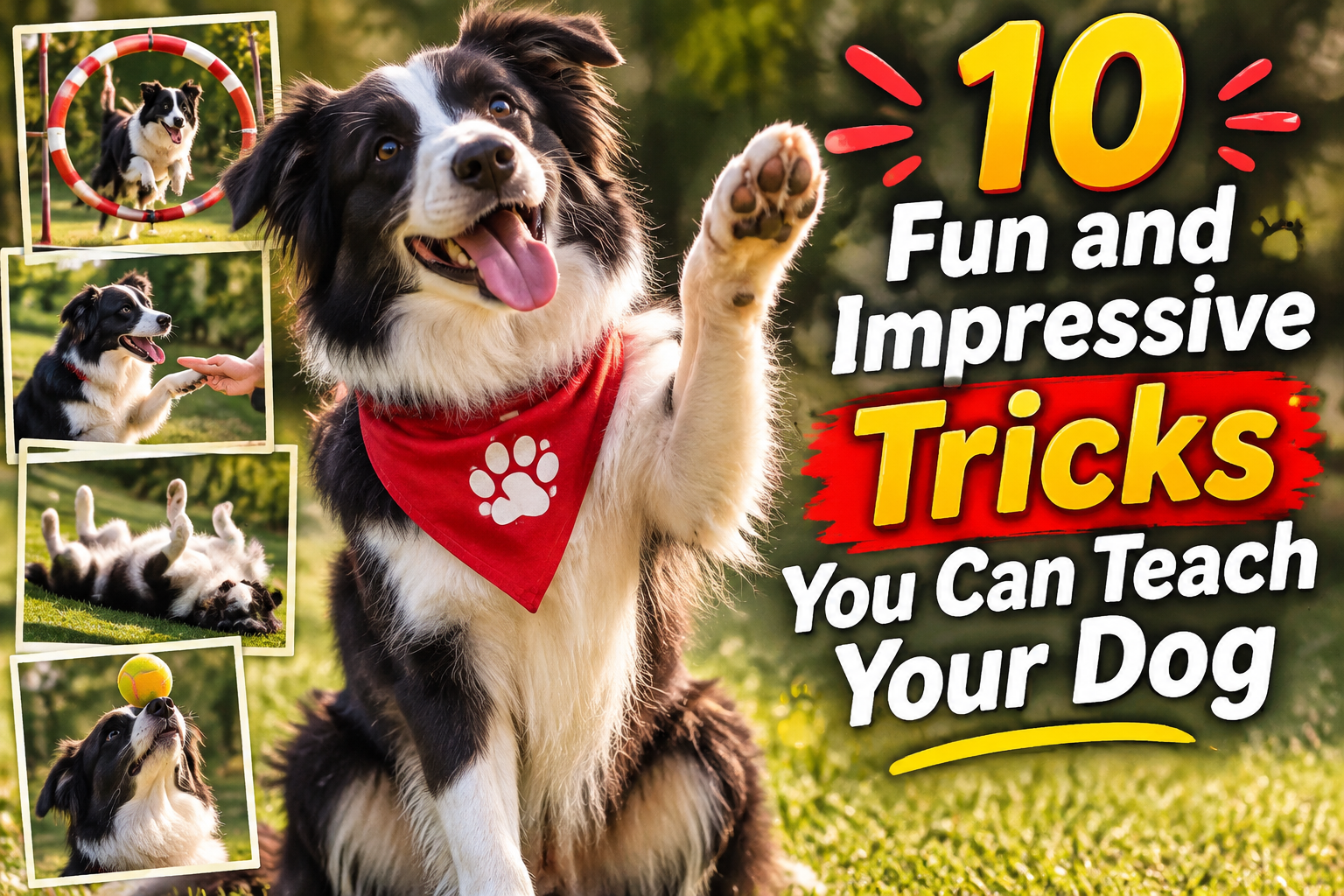
In this guide, we will explore 10 fun and impressive tricks you can teach your dog, with step-by-step instructions, helpful training tips, and advice on making each new skill easier to learn.
Why Should You Teach Your Dog Tricks?
Dog tricks are not simply party entertainment. They can also provide valuable opportunities for learning, communication, and enrichment.
Here are a few reasons to introduce trick training into your dog’s routine.
1. Mental stimulation: Learning a new behavior requires your dog to pay attention, process information, and work out what earns a reward. This provides mental engagement that complements physical exercise.
2. A stronger relationship: Training gives you and your dog an opportunity to communicate and work toward a shared goal. Positive experiences can help strengthen your bond.
3. Better communication: Teaching specific cues helps your dog understand what you want. You also become better at recognizing your dog’s body language and learning pace.
4. Confidence building: Breaking a new trick into manageable steps gives your dog opportunities to succeed. This can help make unfamiliar activities less intimidating.
5. More enjoyable time together: Short training sessions introduce variety into everyday routines and give your dog something interesting to look forward to.
The American Kennel Club discusses how trick training can also help dogs become more comfortable during veterinary visits. You can read its guide on dog trick training for better vet visits.
Before You Start: How to Train Your Dog to Learn New Tricks
Before introducing the tricks, establish a few simple training habits.
Use positive reinforcement
Reward your dog when they perform the behavior you want. Rewards can include small treats, praise, toys, or a short play session.
According to the American Veterinary Society of Animal Behavior, reward-based methods are recommended for dog training because they support learning while avoiding the welfare risks associated with aversive techniques.
Keep training sessions short
Begin with approximately five minutes of practice. You can repeat short sessions throughout the day if your dog remains interested.
Long sessions can lead to frustration, especially when your dog is learning something unfamiliar.
Choose a quiet training area
Start somewhere with minimal distractions. A familiar room is often a better learning environment than a busy park.
Once your dog understands the trick, gradually practise in different locations.
Reward progress, not just perfection
Your dog may not perform the entire trick correctly on the first attempt. Reward small improvements and gradually build toward the finished behavior.
Use consistent commands
Choose a simple word for each trick. If you use “Spin” today and “Turn Around” tomorrow for the same behavior, your dog may become confused.
Everyone participating in training should use the same cues.
Make sure the treats are appropriate
Choose small, dog-safe treats that are easy to eat. You can also use a portion of your dog’s regular food.
Remember that treats should generally account for no more than 10% of your dog’s daily calories, with the remainder coming from a complete and balanced diet. VCA Animal Hospitals explains this in its guide to using food and treats for training dogs.
Now that you have the basics, let’s get started.
10 Fun and Impressive Tricks You Can Teach Your Dog
1. Teach Your Dog to Shake Hands
Difficulty: Easy
What you’ll need: Small training treats.
Shaking hands is one of the classic dog tricks, and it is an excellent starting point for beginners.
It is simple, entertaining, and usually does not require much equipment. Once your dog understands the movement, you can even teach them to offer either paw.
How to teach it:
- Ask your dog to sit comfortably in front of you.
- Hold a small treat inside your closed hand and place it near one of your dog’s front paws.
- Wait for your dog to investigate your hand. Many dogs will eventually lift a paw to reach the treat.
- The moment your dog raises or touches your hand with their paw, mark the behavior with a cheerful “Yes!” and reward them.
- Repeat until your dog begins offering the paw more consistently.
- Introduce the verbal cue “Shake” immediately before presenting your hand.
- Gradually stop using the treat as a lure and reward your dog for responding to the cue.
Training tip: Do not grab or pull your dog’s paw into position. Allow your dog to offer the movement voluntarily.
Once your dog masters one paw, repeat the process with the other and introduce a separate cue such as “Other paw.”
2. Teach Your Dog to Give You a High-Five
Difficulty: Easy
What you’ll need: Training treats.
If your dog already knows how to shake hands, you have a head start.
A high-five is essentially a variation of the paw trick, except your dog learns to touch your raised palm rather than your lowered hand.
How to teach it:
- Ask your dog to sit in front of you.
- Hold your open palm a few inches in front of your dog.
- If your dog already knows “Shake,” use that behavior to encourage a paw movement.
- Reward your dog when their paw touches your palm.
- Gradually raise your hand a little higher as your dog becomes comfortable.
- Introduce the command “High-five!” before presenting your palm.
- Repeat until your dog responds to the cue without needing a food lure.
Training tip: Keep your hand low enough that your dog can reach it comfortably. The objective is a gentle paw tap, not a jump.
3. Teach Your Dog to Spin in a Circle
Difficulty: Easy
What you’ll need: Small treats and a little open floor space.
A dog spinning in a circle on command is a simple trick that often gets an entertaining reaction.
Most dogs can learn the basic movement by following a treat.
How to teach it:
- Stand in front of your dog while they are standing comfortably.
- Hold a treat close to your dog’s nose.
- Slowly move your hand in a circular motion, guiding your dog to follow it.
- As your dog completes a turn, immediately reward them.
- Repeat the movement until your dog starts following the circular hand motion without hesitation.
- Introduce the command “Spin” just before moving your hand.
- Gradually reduce the size of the hand movement until your dog can spin in response to the verbal cue.
Training tip: Keep the turns slow and controlled. Avoid repeatedly spinning your dog in one direction or making them dizzy.
Once your dog learns one direction, you can introduce a separate cue such as “Reverse” for turning the other way.
4. Teach Your Dog to Touch Your Hand
Difficulty: Easy
What you’ll need: Training treats.
This trick is sometimes called hand targeting, and it is one of the most useful skills you can teach your dog.
The idea is simple: your dog learns to touch your open palm with their nose when you give a cue.
Besides being entertaining, hand targeting can help guide your dog into position during other training exercises.
How to teach it:
- Hold your open palm a few inches away from your dog’s nose.
- Allow your dog to investigate your hand.
- The moment their nose touches your palm, say “Yes!” and reward them.
- Repeat until your dog begins deliberately touching your hand.
- Introduce the command “Touch” before presenting your palm.
- Gradually move your hand to different positions so your dog learns to follow the target.
- Practise in different rooms once your dog understands the trick.
Training tip: Do not push your hand into your dog’s face. Let your dog approach it voluntarily.
Hand targeting is especially useful because it can become the foundation for more advanced activities.
5. Teach Your Dog to Speak on Command
Difficulty: Moderate
What you’ll need: Treats and a suitable training environment.
Imagine asking your dog a question and having them respond with a bark on command.
Teaching “Speak” can be entertaining, but it requires careful practice. You want your dog to bark when asked, not become more vocal throughout the day.
How to teach it:
- Observe situations in which your dog naturally barks, such as during an exciting game.
- Choose a safe, familiar situation that encourages a bark without frightening or stressing your dog.
- Just before the expected bark, say “Speak.”
- When your dog barks, immediately mark the behavior and provide a reward.
- Repeat until your dog begins connecting the word with the action.
- Gradually reduce the original trigger.
- Practise in a calm environment and reward only the bark that follows your cue.
Training tip: It is important to teach a quiet cue as well.
To introduce “Quiet,” wait for a brief pause in barking, say the cue, and reward the silence. Gradually increase the amount of quiet time before rewarding.
If your dog already struggles with excessive barking, skip this trick until you have addressed the underlying behavior.
6. Teach Your Dog to Fetch and Drop the Toy
Difficulty: Easy to moderate
What you’ll need: A suitable dog toy and treats.
Fetch is more than a game of throwing a ball. When taught properly, it can help your dog learn several useful behaviors, including retrieving, returning, and releasing an object.
Some dogs naturally enjoy chasing toys, while others need encouragement to understand the game.
How to teach it:
- Choose a toy your dog enjoys and encourage them to interact with it.
- Allow your dog to pick up the toy and reward them for holding it.
- Toss the toy a short distance across a safe, open area.
- Encourage your dog to approach and collect it.
- Call your dog back using a cheerful “Come” cue.
- When your dog returns, present a treat or another toy as an exchange.
- Introduce the command “Drop it” when your dog releases the toy.
- Repeat the sequence, gradually increasing the distance when your dog is ready.
Training tip: Never chase your dog around the house trying to retrieve a toy. That can turn the exercise into a game of keep-away.
Instead, reward your dog for bringing the object back and releasing it willingly.
7. Teach Your Dog to Bow
Difficulty: Moderate
What you’ll need: Small treats.
A dog bowing on command looks like a little performance. Your dog lowers their front legs while keeping their hindquarters raised.
It is an entertaining trick, but it also requires your dog to be comfortable moving into the position.
How to teach it:
- Begin with your dog standing comfortably.
- Hold a treat close to their nose.
- Slowly move the treat downward toward the floor and slightly back toward their chest.
- Reward your dog if they lower their front end while keeping their back legs standing.
- Repeat the movement in small stages until your dog begins offering the complete bow.
- Introduce the command “Bow” before guiding the movement.
- Gradually reduce the treat lure and reward the completed action.
Training tip: Keep the exercise gentle. Do not push your dog’s shoulders downward or force them into position.
If your dog struggles to maintain the posture, becomes uncomfortable, or has mobility problems, choose another trick.
8. Teach Your Dog to Play Dead
Difficulty: Moderate
What you’ll need: Training treats and a comfortable surface.
This is one of the most entertaining tricks you can teach a dog.
When your dog learns to lie on their side and remain still after hearing a cue, it can look like they are pretending to fall asleep or play dead.
The secret is to build the movement gradually rather than expecting your dog to perform everything at once.
How to teach it:
- Start with your dog lying comfortably on their stomach.
- Hold a treat near their nose.
- Slowly move the treat toward one shoulder so your dog turns their head.
- As your dog shifts their weight toward one side, reward the movement.
- Gradually guide them into a comfortable side-lying position.
- Introduce the cue “Play dead” once your dog understands the movement.
- Reward your dog for remaining in position briefly.
- Slowly increase the duration as they become more comfortable.
Training tip: Never force your dog onto their back or side. Some dogs dislike these positions, and dogs with joint or spinal problems may need to avoid the trick entirely.
A comfortable side-lying position is enough. There is no need to make your dog perform a dramatic roll.
9. Teach Your Dog to Rest Their Chin on Your Hand
Difficulty: Easy to moderate
What you’ll need: Treats and a comfortable place to sit.
This is a particularly sweet trick. Your dog learns to place their chin gently in your open palm and hold it there until released.
It may look like your dog is resting their head in your hand, but it is also a useful foundation for cooperative handling exercises.
How to teach it:
- Sit comfortably in front of your dog.
- Place your open palm just below their chin.
- Wait for your dog to lower their head or make contact with your hand.
- Mark the moment their chin touches your palm and reward them.
- Repeat until your dog deliberately rests their chin in your hand.
- Introduce the cue “Chin” or “Rest.”
- Gradually encourage your dog to hold the position for one or two seconds before receiving a reward.
Training tip: Keep your hand relaxed and allow your dog to move away whenever they want.
Never hold your dog’s head in place or use the trick to restrain an uncomfortable animal.
10. Teach Your Dog to Find a Hidden Treat
Difficulty: Easy to moderate
What you’ll need: Small dog-safe treats and a few hiding places.
This trick uses your dog’s natural ability to investigate scents.
Rather than relying on complicated movements, your dog learns to search for something hidden and find it when you give a cue.
It is a fun way to encourage exploration and provide mental enrichment.
How to teach it:
- Let your dog see you holding a small treat.
- Place the treat somewhere easy to find, such as beside a chair.
- Say “Find it!” and encourage your dog to investigate.
- When your dog discovers the treat, allow them to eat it.
- Repeat with slightly different hiding places.
- Once your dog understands the game, hide the treat while they are briefly out of sight.
- Gradually make the hiding locations more challenging.
Training tip: Start with obvious hiding places and increase the difficulty slowly.
Use only safe, accessible locations. Avoid hiding food near electrical cables, household chemicals, fragile objects, or anywhere your dog might become stuck.
For an extra challenge, use a few pieces of your dog’s regular kibble rather than adding lots of extra treats.
How Long Does It Take to Teach a Dog a New Trick?
There is no universal timeline.
Some dogs learn simple behaviors such as shaking hands or touching a palm within a few short sessions. More complicated tricks may require days or weeks of consistent practice.
Several factors influence how quickly your dog learns:
- Age: Puppies, adults, and senior dogs can all learn, although their attention spans and physical abilities may differ.
- Motivation: Some dogs work enthusiastically for treats, while others prefer toys, games, or praise.
- Previous training: Dogs familiar with basic cues may understand new exercises more quickly.
- Environment: Distractions can make learning harder, especially during the early stages.
- Physical ability: A trick that requires balance or unusual movement may not suit every dog.
The important thing is not how quickly your dog learns. It is whether the training experience remains enjoyable and comfortable.
Common Mistakes to Avoid When Teaching Dog Tricks
Even well-intentioned owners sometimes make training harder than necessary.
Watch out for these mistakes:
Training for too long: Long sessions can cause frustration and reduce your dog’s interest. Keep practice short and finish while your dog is still engaged.
Repeating commands excessively: Saying “Spin, spin, spin” will not necessarily help your dog understand. Give the cue once, make the exercise easier if needed, and reward progress.
Using punishment: Shouting, hitting, leash corrections, or intimidation can create fear and undermine trust. Reward the behavior you want instead.
Expecting every dog to learn at the same speed: Your dog is an individual. Allow them to learn at a pace that suits their abilities.
Making tricks physically uncomfortable: Not every dog should jump, balance upright, roll over, or perform demanding movements. Consider your dog’s age, weight, joint health, and mobility.
Forgetting to reward good behavior: Your dog needs clear feedback. Mark the correct action and deliver the reward promptly.
For additional guidance, read our DogsVets guide to effective dog training techniques.
Frequently Asked Questions About Teaching Dogs Tricks
What is the easiest trick to teach a dog?
Shake hands, nose targeting, and simple spins are among the easiest tricks for many dogs. They involve straightforward movements and can be taught using small rewards and positive reinforcement.
Can older dogs learn new tricks?
Absolutely. Older dogs can continue learning throughout their lives. Choose exercises that suit their mobility, energy, and health. Avoid demanding movements if your dog has arthritis or other physical limitations.
How many tricks should I teach my dog at once?
Start with one or two tricks and build gradually. Once your dog understands the behaviors, you can introduce additional skills without overwhelming them.
How often should I train my dog?
Try short sessions of around five minutes, once or several times a day, depending on your dog’s interest and attention. Consistency is more useful than exhausting your dog with lengthy sessions.
Can I teach my dog tricks without treats?
Yes. Treats are not the only reward available. Some dogs respond well to toys, playtime, praise, or affection. The important thing is finding something your dog genuinely enjoys.
Is it too late to teach my dog tricks?
No. There is no age at which a healthy dog automatically loses the ability to learn. You may need to adjust the difficulty and pace, but older dogs can still enjoy learning new skills.
Are dog tricks good mental exercise?
Yes. Trick training encourages dogs to pay attention, make associations, and work through small challenges. It can provide useful mental enrichment alongside appropriate physical activity.
Final Thoughts: Make Learning Fun for Your Dog
Teaching your dog tricks is one of those activities that can turn an ordinary afternoon into something memorable.
Whether your dog learns to shake hands, spin, fetch a toy, or find a hidden treat, every new skill creates another opportunity to communicate and spend quality time together.
You do not need a naturally gifted dog or professional training experience to get started. What matters most is patience, consistency, appropriate rewards, and an understanding of your dog’s individual abilities.
Start with one simple trick. Celebrate small improvements. Keep the sessions enjoyable, and allow your dog to learn without pressure.
You might be surprised by what your four-legged companion can accomplish.
After all, the best trick is not necessarily the one that impresses your friends. It is the one that makes learning enjoyable for both you and your dog.