Last Updated on July 11, 2026 by Dogs Vets
Losing sight of your dog for even a few minutes is every owner’s nightmare. Whether your pup is an escape artist who clears the backyard fence, a hunting dog ranging through thick cover, or simply a curious wanderer, a GPS tracker turns panic into a location on your phone. But with dozens of models, competing technologies, and confusing subscription plans, choosing the right one is genuinely hard. This guide walks you through every decision that matters so you can buy once and buy right.
Why a GPS Tracker Is Worth It
A microchip proves ownership when someone finds your lost dog, but it cannot tell you where your dog is right now. That is the job of a GPS tracker. It pinpoints your dog’s real-time location, alerts you the moment they leave a safe zone, and — in the models worth buying — updates that location several times a minute when your dog is genuinely lost.
Think of the two as partners, not substitutes. Experts consistently recommend using a GPS tracker alongside a permanent microchip, never instead of one [[srcs: The Best Pet Trackers and GPS Dog Collars for 2025: you should use trackers in conjunction with microchips in a pet, not as a substitute ]]. The chip is your safety net; the tracker is your search party.
The Two Main Types of Dog Trackers
Before comparing brands, understand that “dog tracker” covers three very different technologies.
True GPS + cellular (LTE) trackers. These are the real deal for finding a lost dog. The device gets a satellite fix, then sends that location to your phone over a cellular network using its own built-in SIM. Because they do not depend on other people’s phones being nearby, they work in open countryside, forests, and rural areas. Tractive, Fi, Garmin, Invoxia, Halo, and SATELLAI all fall in this camp [[srcs: Best GPS Dog Tracker 2026 — 9 Trackers Honestly Compared: if the tracker has its own SIM. Tractive, Fi, Invoxia and SATELLAI use 4G/LTE ]].
Bluetooth tags. Apple AirTag and Samsung SmartTag are cheap and battery-frugal, but they are not true GPS. They rely on nearby phones in the manufacturer’s network to report a location, so they work as an urban safety net at best and fail completely in rural areas. Apple itself warns that AirTag is designed to track items, not pets — and its coin battery is toxic if a dog swallows it, so always use a sturdy holder [[srcs: Best GPS Dog Tracker 2026: Apple itself warns: “AirTag is designed to track items, not pets.” Also: the CR2032 battery is toxic ]].
GPS containment / fence systems. Products like SpotOn and the Halo Collar create virtual, GPS-drawn boundaries and warn or correct the dog at the edge. These are for keeping a dog in an area rather than finding one that is already gone, and they are considerably more expensive [[srcs: Best GPS Dog Collars of 2026, Tested and Reviewed: Best for Keeping Dogs in the Yard: SpotOn ]].
For most owners who want to find a lost dog, a true GPS + cellular tracker is the answer.
The Seven Factors That Actually Matter
1. Battery Life
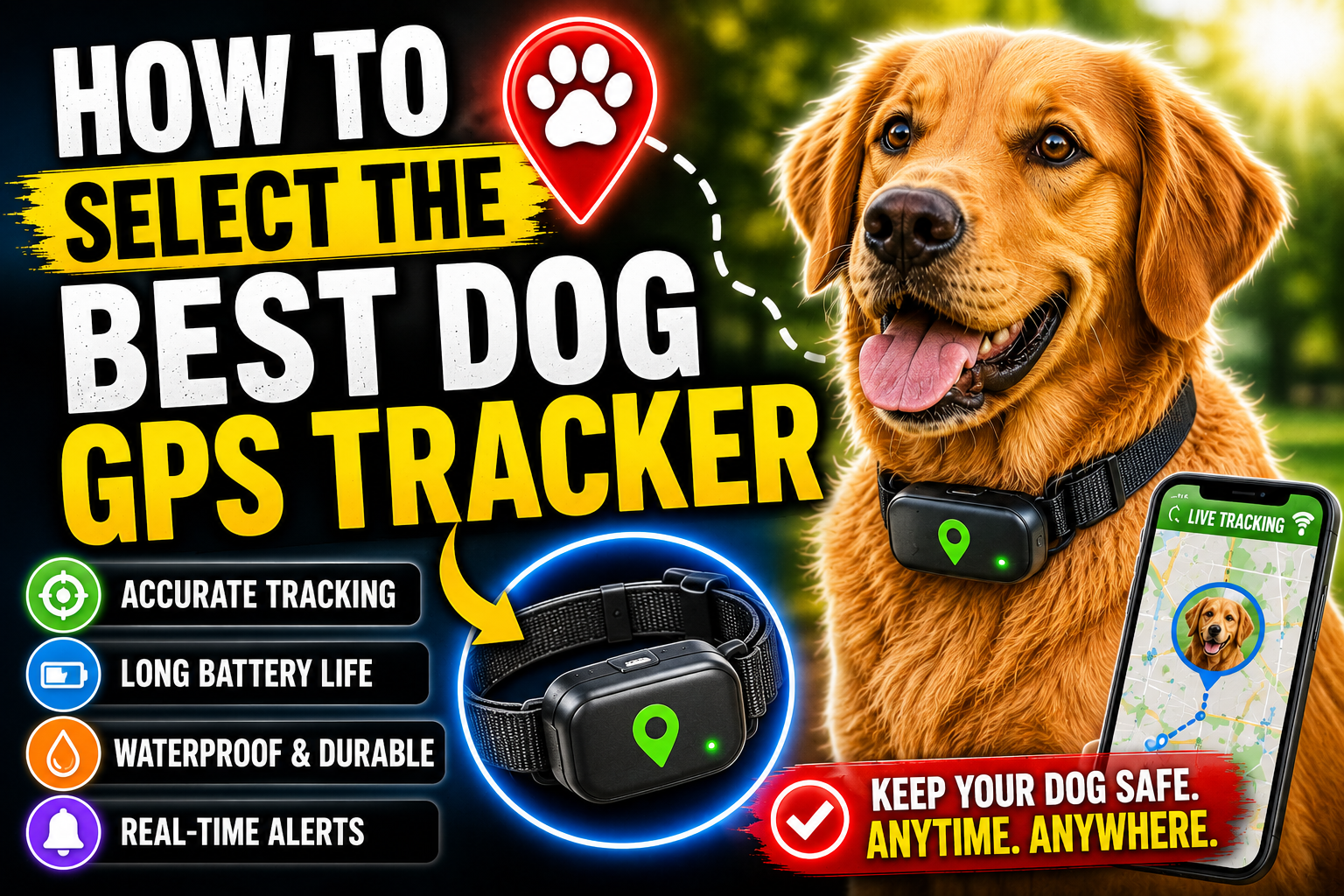
This is arguably the single most important spec. If the battery dies, so does your ability to find your dog. Look at two numbers: normal standby life and life in “Lost Dog” or “Live” mode, which drains far faster because it updates constantly.
The range is enormous. Fi advertises up to three months of everyday battery life, Tractive’s DOG 6 runs about two weeks, while containment collars like the Halo 5 last only around 20 hours [[srcs: Best GPS Dog Tracker 2026: Battery life | 14 days | 3 months | … | Up to 20 hours ]]. Larger trackers generally pack bigger batteries, so bigger dogs can often carry a longer-lasting device [[srcs: How to Select the Best Dog GPS Tracker: larger trackers tend to have a longer battery life, which is one of the most important features ]]. If you own a skittish dog that can take days or weeks to recover once lost, prioritize battery life above almost everything else.
2. Cellular Coverage Where You Live
A GPS tracker is only as good as the network it sends data over. Both the tracker and your phone need coverage for a location to reach you. Before buying, check which carrier a tracker uses in your region: Fi runs on AT&T’s LTE-M network in the US, while Tractive operates its own SIM across 175+ countries and is the stronger choice in Europe [[srcs: Best GPS Dog Tracker 2026: Tractive has stronger European 4G/LTE coverage than Fi (American) ]]. Buying a US-centric device for a rural European home — or vice versa — is a common, costly mistake.
3. Size, Fit, and Weight
A tracker that is too bulky for a small dog is a non-starter. Match the device to your dog’s neck size and weight, and remember the trade-off: slimmer trackers are more comfortable but usually have shorter battery life. Everyday collars like the Fi integrate the tracker into a slim band, while hunting units from Garmin are deliberately large and heavy because they prioritize range and battery over comfort [[srcs: Best GPS Dog Collars of 2026: The GPS unit on the collar was the bulkiest and heaviest in the test ]].
4. Durability and Waterproofing
Dogs swim, roll in mud, and crash through brush. Look for an IP67 or IP68 rating. IP68 means the device is fully dust-tight and can be submerged (typically up to 1.5 meters for 30 minutes); the Fi 3+ goes further with an IP68 +66K rating that adds protection against high-pressure water jets [[srcs: How to Select the Best Dog GPS Tracker: All the trackers had the same waterproof rating of IP68 … Only the Fi 3+ had an IP68 +66K rating ]].
5. Total Cost, Including Subscription
The sticker price is only part of the story. Almost every true GPS tracker requires an ongoing subscription for the cellular network, and it adds up fast. Typical 2026 figures: Tractive around €69 device plus €84/year, Fi around $149 plus roughly $99/year, and premium systems like the Halo running $799 plus $129/year [[srcs: Best GPS Dog Tracker 2026: Tractive EUR 69 + EUR 84/year — Fi USD 149 + USD 99/year – … Halo USD 799 + USD 129/year ]]. A rare few — hunting units like the SportDog Tek 1.5 and Bluetooth tags — are one-time purchases with no monthly fee [[srcs: Best GPS Dog Collars of 2026: There are no ongoing subscriptions or extra purchases required to use the Tek 1.5 ]]. Budget for the first and second year before you decide.
6. Accuracy and Update Frequency
When your dog is missing, how often the tracker refreshes its location — and how accurate that location is — determines whether you can actually catch up. The best everyday trackers update three to five times per minute in Lost Dog mode. Test this yourself: the strongest models like Fi and Tractive give an up-to-date fix almost instantly wherever there is coverage [[srcs: How to Select the Best Dog GPS Tracker: It provided location updates 3 to 5 times per minute in Lost Dog Mode ]].
7. App Quality and Extra Features
You will live inside the companion app, so check its rating in the App Store or Google Play before buying — a poorly-reviewed app is a red flag for daily frustration [[srcs: How to Select the Best Dog GPS Tracker: take a quick look at the app ratings for your phone operating system ]]. Many trackers now add activity, sleep, and step monitoring — useful, but treat pet “temperature” readings with skepticism, as testers find them unreliable [[srcs: The Best Pet Trackers and GPS Dog Collars for 2025: we’ve found temperature readings to be fairly inaccurate ]].
Matching the Tracker to Your Dog
There is no single “best” tracker — only the best for your situation [[srcs: How to Select the Best Dog GPS Tracker: there is no best tracker that I recommend for every dog ]].
- Everyday family dog: The Fi Series 3 is a repeated top pick for its slim design, long battery life, and fast updates.
- Best value / global coverage: Tractive DOG 6 is more accurate on frequent updates, far cheaper, and works in the most countries.
- Skittish or escape-prone dog: Prioritize the longest possible battery life (Fi), since recovery can take days.
- Hunting or working dog off-grid: A Garmin TT-series collar with a handheld gives you miles of range and mapping without depending on cell coverage.
- Containment, not finding: SpotOn or Halo create GPS fences to keep a dog home.
Test Before You Trust
Never assume a tracker works — verify it. Most reputable brands offer a 30-day satisfaction guarantee, so buy, then test [[srcs: How to Select the Best Dog GPS Tracker: many trackers come with a 30-day satisfaction guarantee return policy ]]. Walk the collar (or have a helper hold your dog) more than 30 feet away, beyond Bluetooth range, then switch on Lost Dog mode and time how long it takes to show an accurate location. Repeat this both near home and at parks or trails you visit often. If it is slow or wrong where you actually go, return it and try another.
Final Word
The best dog GPS tracker is the one that fits your dog, reaches your phone reliably where you live, holds a charge long enough to matter, and fits your budget across two years — not just the one with the flashiest marketing. Nail those four, pair it with a microchip, and test it in the real world. Your dog’s safety is worth far more than the price of the device.
Frequently Asked Questions
1. Do dog GPS trackers require a monthly subscription?
Most true GPS trackers do, because they use a cellular network with a built-in SIM to send locations. Expect roughly $99/year (Tractive, Fi) up to $129/year for premium systems. Exceptions are Bluetooth tags like AirTag and one-time-purchase hunting units like the SportDog Tek 1.5, which have no recurring fee [[srcs: Best GPS Dog Collars of 2026: no ongoing subscriptions or extra purchases required to use the Tek 1.5 ]].
2. Is an Apple AirTag good enough to track my dog?
Only as a limited urban safety net. AirTags have no GPS chip and depend on nearby iPhones to report a location, so they are unreliable in rural areas. Apple explicitly says AirTags are made for items, not pets, and the battery is dangerous if swallowed — always use a protective holder [[srcs: Best GPS Dog Tracker 2026: AirTag has no GPS chip — it relies on other people’s iPhones nearby ]].
3. How long does the battery last on a dog GPS tracker?
It varies dramatically — from about 20 hours on containment collars, to two weeks on a Tractive DOG 6, to up to three months on a Fi Series 3. Lost Dog / Live mode drains the battery much faster, so factor that in [[srcs: Best GPS Dog Tracker 2026: Battery life | 14 days | 3 months ]].
4. Can I use one GPS tracker for both my dog and my cat?
Not always. Many trackers are too large or heavy for cats, and their motion algorithms are tuned for canine movement. Check the size, weight, and whether the manufacturer specifically supports cats before buying [[srcs: The Best Pet Trackers and GPS Dog Collars for 2025: Many of the devices available in the market are a bit too big to effectively work on cats ]].
5. Does a GPS tracker replace a microchip?
No. A tracker shows real-time location but can lose charge or signal; a microchip is a permanent ID that any vet or shelter can scan to reunite you with your dog. Use both together for full protection [[srcs: The Best Pet Trackers and GPS Dog Collars for 2025: use trackers in conjunction with microchips in a pet, not as a substitute ]].
Reference Links
- Lost Pet Research & Recovery — How to Select the Best Dog GPS Tracker
- Outdoor Life — Best GPS Dog Collars of 2026, Tested and Reviewed
- Yahoo Tech / PCMag — The Best Pet Trackers and GPS Dog Collars
- Consumer Reports — Best GPS Pet Trackers
- Camicoo — Best GPS Dog Tracker 2026 — 9 Trackers Compared