Last Updated on October 29, 2026 by Dogs Vets
When Is a Puppy Ready for an Agility Course for Dogs in Atlanta?
Agility can give puppies a fun way to build confidence, coordination, and communication with their owners. The right starting point is not a full-speed course, but age-appropriate practice with a qualified instructor.
A beginner agility course for dogs may introduce simple obstacles gradually. Before enrolling, ask how the class adapts activities for puppies and what your veterinarian recommends for your dog’s development.
Start with confidence and communication
Before adding equipment, help your puppy get comfortable with everyday sounds, surfaces, people, and calm environments. Keep introductions brief and positive. Let your puppy observe from a comfortable distance, and pause if they show signs of fear or fatigue.
The American Veterinary Society of Animal Behavior identifies the first three months as an especially important socialization period. Its guidance supports safe, positive exposure before puppies complete their full vaccination series, while recommending care around unsanitized or heavily trafficked places with dogs of unknown health status. Ask your veterinarian which settings are appropriate for your puppy.
Practice short moments of attention, responding to a name, and following a treat or toy. These simple activities build communication without asking a young dog to perform a full obstacle sequence.
Build skills before adding obstacles
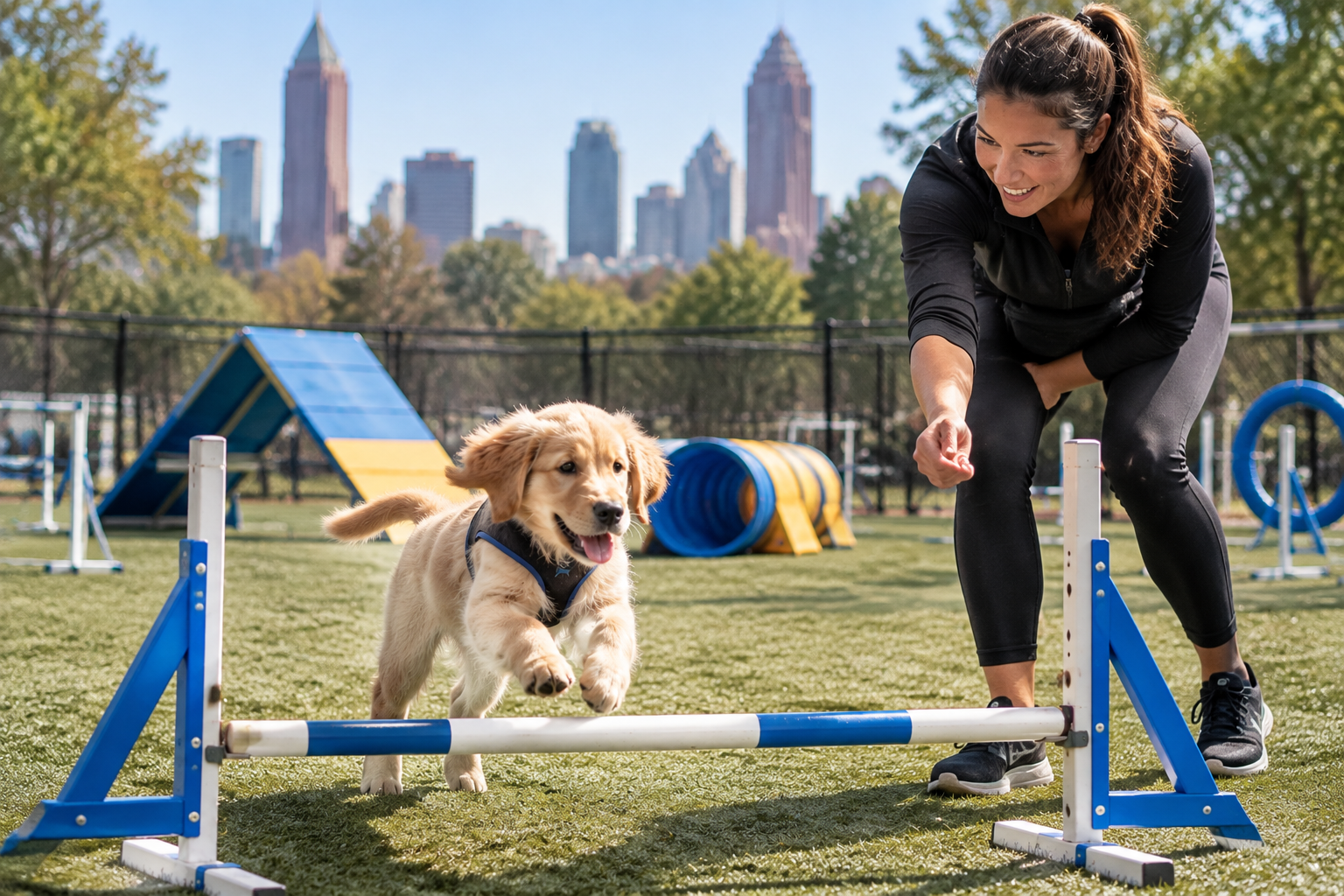
Early agility foundations can focus on body awareness and confidence rather than speed. With suitable supervision, puppies can practice:
- Walking across safe, unfamiliar surfaces.
- Following a treat through gentle turns.
- Coming when called in a quiet setting.
- Stepping over low, ground-level poles.
- Exploring a tunnel at their own pace.
Keep sessions short and reward curiosity, calm focus, and willingness to try. A puppy does not need to master every skill at once. Repeating an activity while the dog remains comfortable is more useful than pushing through hesitation.
Avoid repeated high jumps, strenuous sequences, or advanced equipment until your veterinarian and a qualified instructor say those activities fit your puppy’s physical development. A puppy-ready class should adjust the equipment and pace, not expect every dog to follow the same progression.
Choose a puppy-appropriate class
Ask whether the instructor has experience working with puppies, how obstacles are modified, what vaccination rules apply, and how class size and rest breaks are managed. Find out whether owners work alongside their dogs and what signs mean a puppy needs a break.
Prior obedience training is not required by every beginner class. For example, Atlanta Dog Trainer’s basic agility information says puppies progress at their own pace and no prior obedience training is required. That is one local option, not a substitute for checking whether a particular class fits your puppy.
Compare classes by supervision, training methods, age policies, and the instructor’s approach to nervous or tired dogs. A suitable first class should make safety and confidence more important than speed, height, or completing a course.
When board and train serves a different goal
Agility classes teach obstacle skills with an owner participating. A residential program may instead focus on obedience and everyday manners. If comparing a board and train Atlanta option, check the curriculum and how owners are taught to continue the work at home.
Atlanta Dog Trainer, one of Atlanta’s leading dog training facilities, offers a program with a minimum enrollment age of 3½ to 4 months and a minimum stay of two weeks. The program also includes a pre-enrollment evaluation and a go-home lesson to help owners reinforce their dog’s training. These requirements are specific to Atlanta Dog Trainer’s program and do not apply to agility classes in general.
FAQs
Can puppies socialize before they are fully vaccinated?
Safe, managed socialization can begin before a puppy completes the full vaccine series. Follow your veterinarian’s guidance, keep vaccinations current, and avoid unsanitized or heavily trafficked areas where dogs’ health status is unknown. AVSAB’s position statement explains these recommendations.
Does a puppy need obedience training before an agility class?
Requirements vary by program. Some beginner classes accept puppies without prior obedience training, while still adapting activities to each dog’s age, comfort, and attention. Ask the instructor what skills are expected before signing up.
Is board and train the same as an agility class?
No. Board and train is a residential training format, while agility classes teach obstacle skills with an owner present. Check the provider’s curriculum, since the two programs may have different goals and eligibility requirements.
A puppy can begin agility with simple, supervised activities that build confidence and communication. Choose a class that adjusts to your dog’s development, and ask your veterinarian or instructor before moving to more demanding obstacles.