Last Updated on October 12, 2026 by Dogs Vets
If you’ve spent any time on Reddit’s pet-loss communities, you’ve seen the same question over and over:
“My dog died last week/month… is it too soon to get another one?”
“I feel guilty, like I’m replacing him.”
“I got a new dog too soon and now I can’t bond with her—I keep comparing her to my old one.”
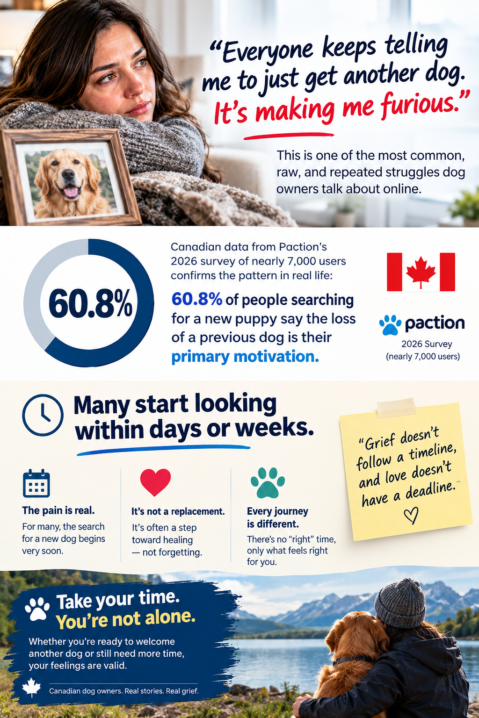
“Everyone keeps telling me to just get another dog. It’s making me furious.”
This is one of the most common, raw, and repeated struggles dog owners talk about online. Canadian data from Paction’s 2026 survey of nearly 7,000 users confirms the pattern in real life: 60.8% of people searching for a new puppy say the loss of a previous dog is their primary motivation. Many start looking within days or weeks.
The problem isn’t wanting another dog. The problem is doing it from a place of raw grief without a clear plan—and then feeling stuck with guilt, comparison, or a dog that doesn’t fit your life.
Here’s a practical, no-fluff guide based on what actually helps people move forward without the common regrets.
Why Rushing So Often Backfires
Grief after losing a dog is real and intense. Many owners describe it as losing a family member. When the house is suddenly quiet, the routines disappear, and the loneliness hits, the urge to fill the gap is powerful.
But Reddit is full of stories where people adopted within days or a couple of weeks and later felt:
- Constant comparison (“She’s not as calm/smart/loving as my old dog”)
- Guilt (“Am I betraying my previous dog?”)
- Resentment toward the new dog
- Exhaustion from puppy energy or behaviour issues while still grieving
- A deepened sense of loss instead of healing
The opposite also happens: some people find that a well-matched new dog helps them heal. The difference is almost always timing + intentional choice rather than pure impulse.
A Simple Framework That Actually Works
There’s no universal “right” number of weeks or months. What works better is a short checklist most people who successfully navigate this use:
- Can you still function day-to-day without a dog?
If the silence is unbearable and you’re spiralling, that’s information—not a green light to adopt tomorrow. Consider fostering first or spending time with friends’ dogs to test how it feels. - Are you ready to meet a completely different dog?
The new dog will not be your old dog. Different personality, different quirks, different needs. If you’re still actively hoping for a replica, wait a bit longer. - Have you run the real numbers for your life right now?
Canadian costs have climbed. Expect $3,000–$5,100+ per year for a typical dog (food, routine vet care, preventatives, grooming, licensing). First-year costs for a puppy often hit $5,000–$6,500+ before the purchase or adoption fee. Pet insurance runs roughly $30–$100+ a month. Two-thirds of Canadian owners previously admitted they under-estimated ongoing costs. Don’t let grief cloud the budget. - Does your current lifestyle still match the kind of dog you want?
Canada’s winters are long and harsh. Thick-coated, outdoor-oriented breeds (Labs, Goldens, Bernese, certain working dogs) handle cold better. High-energy herding or sporting breeds need consistent exercise even in –20 °C. Apartment or condo living changes the equation again. The Labrador Retriever has been Canada’s most registered purebred for 32 straight years for good reason—friendly, adaptable, and weather-tolerant—but only if your daily life can support it.
Practical Steps That Reduce Regret
- Start with fostering if you’re unsure. Many Canadian rescues let you foster-to-adopt. You get companionship without the full long-term commitment while you process.
- Choose a different look or energy level deliberately. Some people find it easier to bond when the new dog doesn’t look exactly like the one they lost.
- Talk to the people you live with. One partner may be ready while the other is not. Forcing it creates tension that the new dog will feel.
- Budget for training and support. A new dog (especially a puppy or reactive rescue) requires time and sometimes professional help. Grieving while also managing a behaviour challenge is hard.
- Allow yourself to feel both things at once. You can miss your old dog deeply and still love a new one. They are not in competition.
The Canadian Reality Check
We live in a country with real winters, varying housing costs, and a strong culture of treating dogs as family (87% of Canadian pet owners say their pet is a full family member). The Paction data shows many of us jump back into ownership quickly after loss. That doesn’t make it wrong—it just means the decision deserves more thought than an emotional impulse buy.
If you’re in the middle of this right now: the quiet house hurts. The guilt is common. The comparison is normal at first. Most people who wait until they can honestly say “I want to give a new dog a good life” rather than “I need to stop feeling this pain” end up happier with the outcome.
There’s no prize for getting another dog the fastest. There’s only the dog who will share the next chapter of your life. Make sure you’re ready to show up for that dog the way your previous one deserved.