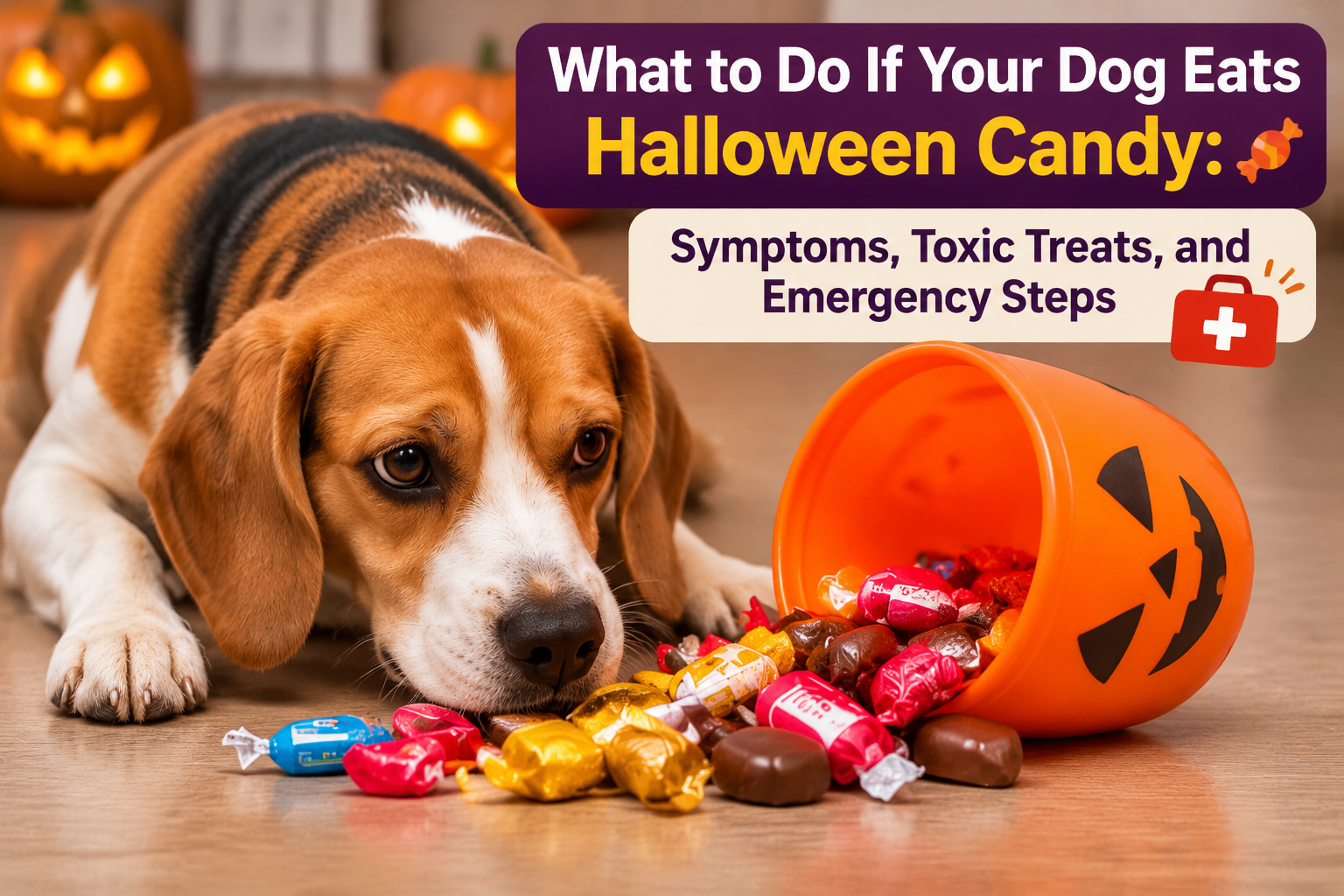
Halloween brings costumes, decorations, trick-or-treat bags, and bowls filled with candy. Unfortunately, those treats can create serious health risks for curious dogs.
A dog that sneaks a piece of candy may experience an upset stomach. But some Halloween treats contain ingredients that can cause severe poisoning, including chocolate, xylitol, and raisins. Swallowed candy wrappers and lollipop sticks can also create choking or intestinal blockage risks.
If your dog has eaten Halloween candy, contact your veterinarian promptly. Do not wait for symptoms if the candy contains a potentially toxic ingredient.
This guide explains which Halloween candies are dangerous, what symptoms to watch for, and what steps to take if your dog gets into a trick-or-treat bag.
Is Halloween Candy Dangerous for Dogs?
Yes. Many Halloween candies are unsuitable for dogs, and some can be toxic even in relatively small amounts.
The level of risk depends on several factors:
- The type of candy and its ingredients.
- The amount your dog consumed.
- Your dog’s weight and overall health.
- Whether wrappers or sticks were swallowed.
- How long ago the candy was eaten.
Some ordinary sugary candies may cause digestive upset without causing poisoning. Others contain substances that can affect the nervous system, blood sugar, heart, or kidneys.
The ASPCA’s Halloween safety guidance specifically warns pet owners about chocolate and sugar-free candy containing xylitol.
What Should You Do If Your Dog Eats Halloween Candy?
If you discover that your dog has eaten Halloween candy, act quickly. The safest response depends on what was consumed and how much your dog ate.
1. Remove the Remaining Candy
Move the candy bowl, trick-or-treat bag, or open package away from your dog immediately.
Check the surrounding area for missing candy, torn wrappers, and discarded packaging. Preventing further ingestion is the first priority.
2. Identify the Candy and Its Ingredients
Look at the packaging and determine exactly what your dog may have eaten.
Check for:
- Chocolate, especially dark or baking chocolate.
- Xylitol in sugar-free candy or gum.
- Raisins or chocolate-covered raisins.
- Macadamia nuts.
- THC or cannabis ingredients.
- Other unusual sweeteners or supplements.
Do not assume that a candy is safe because it does not contain chocolate. Some non-chocolate products contain ingredients that are dangerous to dogs.
3. Estimate How Much Your Dog Ate
Try to determine how many pieces are missing and whether your dog swallowed any wrappers or sticks.
You do not need an exact measurement before contacting a veterinarian. A reasonable estimate is useful, but never delay seeking advice while trying to calculate the amount.
4. Record Your Dog’s Weight and the Time of Ingestion
Your dog’s weight helps veterinary professionals assess the potential exposure.
Also note approximately when the candy was eaten. This can affect which treatment options are appropriate.
5. Call Your Veterinarian or an Animal Poison Control Service
Contact your veterinarian, an emergency veterinary hospital, or an animal poison control service as soon as possible.
Bring the candy packaging or take a photograph of the ingredient list. Tell the veterinary professional about any symptoms and whether wrappers were swallowed.
6. Do Not Induce Vomiting Without Veterinary Instructions
Never give your dog hydrogen peroxide or another substance to make it vomit unless a veterinarian specifically directs you to do so.
Inducing vomiting can be dangerous in certain situations, particularly if your dog is weak, drowsy, having seizures, or has swallowed a sharp or potentially obstructive object.
Avoid home remedies such as milk, oil, salt, or activated charcoal unless a veterinary professional recommends a specific treatment.
Which Halloween Candies Are Toxic to Dogs?
Not every candy presents the same risk. The following are some of the most important Halloween hazards to recognize.
1. Chocolate: A Major Halloween Danger
Chocolate is one of the most common candy-related poisoning concerns for dogs.
It contains two compounds called theobromine and caffeine. Dogs process these substances differently from humans, and consuming enough can affect their nervous system and cardiovascular system.
The risk depends on the type of chocolate, amount eaten, and size of the dog.
Chocolate types of particular concern include:
- Baking chocolate.
- Cocoa powder.
- Dark chocolate.
- Semisweet chocolate.
- Milk chocolate.
- Chocolate-covered candies.
Dark chocolate and baking chocolate generally contain more methylxanthines than milk chocolate, making them more dangerous gram for gram.
Symptoms of chocolate poisoning may include:
- Vomiting and diarrhea.
- Restlessness or unusual excitement.
- Increased thirst and urination.
- Rapid or abnormal heartbeat.
- Tremors.
- Seizures in severe cases.
Signs may take several hours to develop. Do not wait for symptoms before calling your veterinarian.
For more information, read the Merck Veterinary Manual’s explanation of chocolate toxicosis. It explains how chocolate exposure can affect a dog’s heart and nervous system.
2. Sugar-Free Candy and Gum Containing Xylitol
Some sugar-free candies and chewing gums contain xylitol, a sweetener that is highly toxic to dogs.
When a dog consumes xylitol, it can trigger a rapid release of insulin, causing blood sugar to drop dangerously low. Larger exposures can also cause serious liver injury.
Possible signs include:
- Vomiting.
- Weakness.
- Loss of coordination.
- Unusual sleepiness.
- Tremors.
- Seizures.
- Collapse.
Xylitol poisoning is an emergency. Contact a veterinarian immediately if your dog may have eaten a product containing it, even if your dog appears normal.
Check the ingredient list rather than relying on labels such as “sugar-free” or “low sugar.” Product formulations vary.
The Cornell University College of Veterinary Medicine’s xylitol toxicity guide explains the risk of dangerously low blood sugar and liver injury in dogs.
3. Raisins and Chocolate-Covered Raisins
Raisins may appear in snack packs, trail mixes, chocolate-covered treats, and other packaged foods.
Grapes and raisins can cause acute kidney injury in dogs. The exact toxic mechanism is associated with tartaric acid, and individual dogs can respond unpredictably.
There is no reliably safe amount to assume for an individual dog.
If your dog eats raisins or chocolate-covered raisins, contact your veterinarian immediately. Do not wait for symptoms.
Possible signs of grape or raisin poisoning include:
- Vomiting.
- Diarrhea.
- Loss of appetite.
- Weakness or lethargy.
- Increased thirst.
- Changes in urination.
Chocolate-covered raisins create two separate concerns: chocolate exposure and potential raisin toxicity.
4. Candy Corn and Other Very Sugary Candy
Candy corn is not generally considered a classic dog toxin, but that does not make it a suitable dog treat.
Eating a few pieces may cause digestive upset in some dogs. A large amount of sugary or fatty candy can contribute to vomiting, diarrhea, and potentially pancreatitis.
Other examples of sugary Halloween candy include:
- Fruit-flavored chews.
- Gummy candies.
- Caramel candies.
- Hard candies.
- Marshmallow-based sweets.
- Sugar-coated candy pieces.
If your dog eats a large amount, contact your veterinarian for advice, even if the candy does not contain a known toxin.
5. THC-Infused Gummies and Cannabis Edibles
<AsyncImage query=”sealed cannabis THC gummy edible packaging on plain table no people” aspectRatio=”16:9″ width=”100%” />
Some cannabis products resemble ordinary sweets, making them particularly dangerous when stored with Halloween candy.
THC can cause significant neurological effects in dogs, including:
- Stumbling or loss of coordination.
- Unusual sleepiness.
- Disorientation.
- Dilated pupils.
- Urinary incontinence.
- Tremors in some cases.
Cannabis edibles may also contain chocolate, xylitol, or other ingredients that create additional risks.
If your dog eats a THC gummy or another cannabis-infused product, contact a veterinarian immediately.
Read our related guide: What to Do If Your Dog Eats Marijuana.
6. Candy Wrappers and Lollipop Sticks
Even when the candy itself is not toxic, its packaging can create a physical hazard.
Dogs often swallow candy wrappers because they are attracted to the smell and taste of the remaining sweets.
Foil, plastic, cellophane, and other packaging materials may cause choking or intestinal obstruction. Lollipop sticks can also create injury or blockage risks.
Watch for signs such as:
- Repeated vomiting.
- Loss of appetite.
- Abdominal discomfort.
- Unusual tiredness.
- Straining to pass stool.
- Difficulty passing stool.
If you suspect your dog swallowed a wrapper or stick, contact your veterinarian. Do not assume the material will pass safely.
The Pet Poison Helpline’s Halloween safety guide discusses candy wrappers, lollipop sticks, and the possibility of intestinal obstruction.
Symptoms to Watch for After a Dog Eats Halloween Candy
The symptoms depend on the ingredient, amount consumed, and your dog’s response.
Some signs may appear relatively quickly, while others can take hours or longer to develop.
| Symptom | Possible concern |
|---|---|
| Vomiting or diarrhea | Digestive irritation or poisoning |
| Restlessness or agitation | Possible chocolate toxicity |
| Increased thirst or urination | Possible chocolate toxicity |
| Weakness or stumbling | Possible xylitol or THC exposure |
| Tremors or seizures | Serious poisoning |
| Abdominal pain | Gastrointestinal injury or obstruction |
| Loss of appetite | Digestive problems or obstruction |
| Collapse | Potentially life-threatening emergency |
This list is not a diagnostic tool. A dog may have a serious exposure before showing obvious symptoms.
Seek emergency veterinary care if your dog has seizures, collapses, struggles to breathe, becomes difficult to wake, or shows severe weakness.
For suspected chocolate, xylitol, raisin, or THC ingestion, contact a veterinarian immediately even if your dog looks healthy.
How Do Veterinarians Treat Halloween Candy Poisoning?
Treatment depends on what your dog ate, how much was consumed, how long ago it happened, and whether symptoms have developed.
A veterinarian may recommend one or more of the following:
Veterinary Assessment
The veterinarian will review the exposure, assess your dog’s condition, and determine whether testing or treatment is needed.
Depending on the suspected ingredient, tests may include blood glucose measurements, blood chemistry tests, heart monitoring, or imaging.
Inducing Vomiting in Selected Cases
If ingestion occurred recently and the dog is alert and otherwise suitable for the procedure, a veterinarian may decide that inducing vomiting is appropriate.
This is not suitable for every dog or every type of ingestion. Never attempt it at home without veterinary direction.
Activated Charcoal in Selected Cases
A veterinarian may consider activated charcoal for certain toxic exposures. It is not appropriate for every substance and can be dangerous if given to a dog with impaired consciousness or swallowing.
Intravenous Fluids and Medication
Depending on the toxin, treatment may include fluids, medication to control vomiting or seizures, blood glucose support, and other supportive care.
Monitoring and Hospitalization
Dogs with significant chocolate or xylitol exposure may require hospitalization.
Monitoring allows veterinary professionals to watch for changes in heart rhythm, blood glucose, liver function, and other complications.
Dogs with suspected intestinal obstruction may need imaging and, in some cases, surgery.
How to Prevent Your Dog From Eating Halloween Candy
Prevention is the most effective way to avoid candy-related emergencies.
Use these precautions throughout Halloween:
- Store candy securely. Keep candy bowls, bags, and boxes in closed cabinets or containers your dog cannot access.
- Check trick-or-treat bags. Children may leave candy in bedrooms, backpacks, or on the floor.
- Keep sugar-free products away. Read labels and secure gum and sweets containing xylitol.
- Clean up wrappers immediately. Do not leave foil, plastic, or lollipop sticks where dogs can chew them.
- Keep cannabis edibles separate. Store THC gummies and other cannabis products securely, away from ordinary candy.
- Supervise Halloween parties. Guests may accidentally drop sweets or leave drinks and snacks within reach.
- Give your dog suitable treats. Offer dog-safe treats instead of sharing human candy.
- Keep emergency numbers available. Know how to reach your veterinarian and an animal poison control service.
If your dog becomes stressed by frequent visitors and doorbells, provide a quiet, comfortable room away from the front door.
Dog-Safe Halloween Treat Alternatives
Your dog does not need human candy to enjoy Halloween.
You can offer suitable dog treats or small portions of dog-safe foods, provided they are appropriate for your pet’s diet and health.
Some options include:
- Small pieces of plain, cooked pumpkin.
- Carrot pieces.
- Blueberries.
- Small pieces of apple with the seeds and core removed.
- Plain, cooked sweet potato.
- Commercial dog treats appropriate for your dog’s size.
Introduce unfamiliar foods gradually and avoid ingredients that your dog is allergic or sensitive to.
Do not use sugar-free peanut butter or other products without checking the ingredient list for xylitol.
Frequently Asked Questions
1. What should I do if my dog eats Halloween candy?
Remove any remaining candy, identify the product and ingredients, estimate how much was eaten, and contact your veterinarian. Keep the packaging for reference. Do not induce vomiting or give home remedies unless instructed by a veterinary professional.
2. How much chocolate is toxic to a dog?
There is no single amount that is dangerous for every dog. The risk depends on the type of chocolate, the quantity consumed, and the dog’s weight. Dark chocolate and baking chocolate generally contain higher concentrations of toxic compounds than milk chocolate. Contact a veterinarian with these details for an individual assessment.
3. Can one piece of Halloween candy hurt a dog?
It depends on the candy. One ordinary sugary sweet may cause no serious problem, but a small piece of xylitol-containing candy can be dangerous. Chocolate and other ingredients also carry risks that depend on the dog’s size and the product’s composition.
4. What if my dog eats sugar-free Halloween candy?
Check the ingredient list for xylitol and contact your veterinarian immediately if it is present or suspected. Xylitol can cause a rapid drop in blood sugar and potentially serious liver injury. Do not wait for symptoms.
5. Can dogs eat candy corn?
Candy corn is not generally considered a specific toxin, but it is high in sugar and is not an appropriate dog treat. Eating a large amount may cause digestive problems and could contribute to pancreatitis.
6. What happens if my dog eats candy wrappers?
Wrappers may pass through the digestive system, but they can also cause choking or an intestinal obstruction. The risk depends on the material, size, quantity, and dog. Contact your veterinarian if you know or suspect your dog swallowed packaging.
7. How long after eating Halloween candy will symptoms appear?
The timing varies. Some toxic ingredients can cause signs quickly, while chocolate-related symptoms may take several hours to become apparent. Obstruction symptoms may develop later. Do not wait for symptoms before seeking advice about a potentially toxic ingestion.
8. Should I take my dog to the emergency vet after eating Halloween candy?
Go to an emergency veterinary hospital if your dog has severe symptoms such as seizures, collapse, breathing difficulty, or extreme weakness. Suspected ingestion of xylitol, raisins, significant chocolate, or THC products also warrants immediate veterinary advice. Your veterinarian or poison control service can help determine the appropriate level of care.
9. Who should I call if my dog eats Halloween candy?
Contact your veterinarian or an emergency veterinary hospital. In the United States, you can also contact:
- ASPCA Animal Poison Control Center: 888-426-4435. A consultation fee may apply.
- Pet Poison Helpline: 855-764-7661. A consultation fee may apply.
Have your dog’s weight, the candy packaging, estimated amount consumed, and time of ingestion ready if possible.
Final Thoughts
Halloween candy may be a seasonal treat for people, but it can create serious risks for dogs.
Chocolate, xylitol-containing sweets, raisins, cannabis edibles, and swallowed wrappers deserve particular attention. Even candy that is not considered toxic can cause digestive problems when eaten in large amounts.
If your dog gets into a trick-or-treat bag, identify what was eaten and contact a veterinarian promptly. Never assume your dog is safe just because it looks normal.
The simplest prevention is to keep all Halloween candy and packaging securely out of reach and provide your dog with treats made specifically for pets.
Authoritative external references:
- ASPCA — Halloween Safety Tips
- Merck Veterinary Manual — Chocolate Toxicosis in Animals
- Cornell University College of Veterinary Medicine — Xylitol Toxicities
- Pet Poison Helpline — Halloween Pet Safety
- VCA Animal Hospitals — Non-Chocolate Halloween Candy Can Be Toxic to Pets
Before publication: Have a qualified veterinarian review the medical guidance, verify internal URLs, and add author or reviewer credentials only when accurate.