
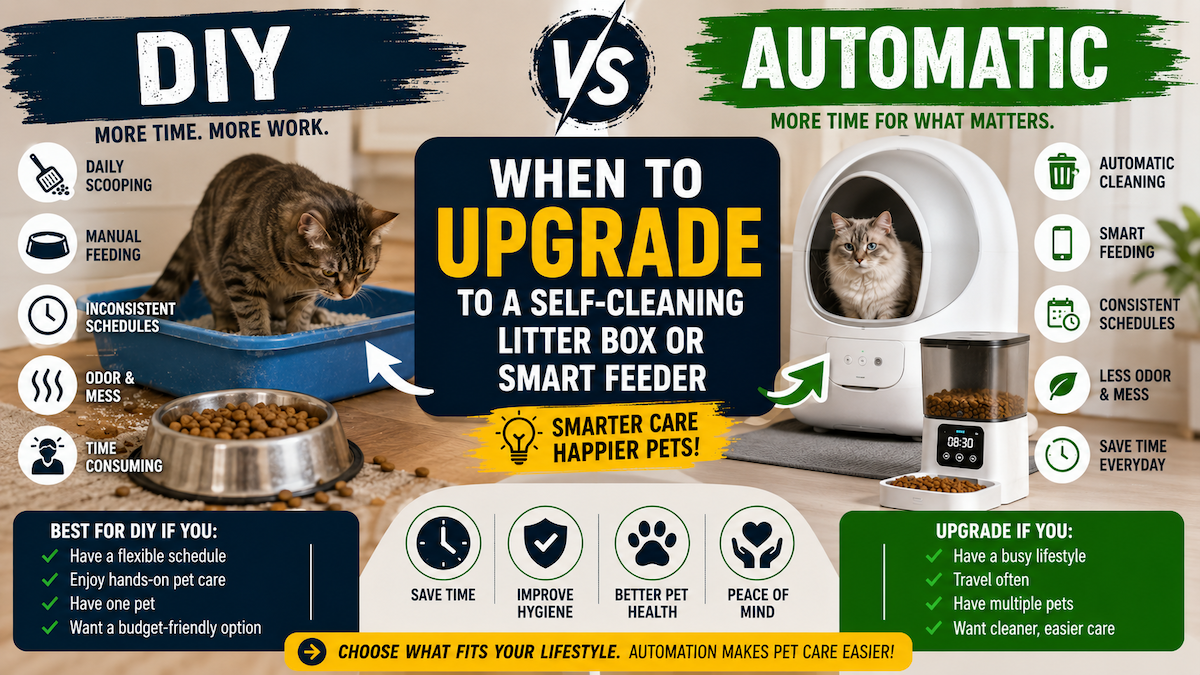
If you’re a pet owner, you already know the daily routine never really stops.
Scooping litter.
Refilling food bowls.
Cleaning messes.
Managing odors.
Trying to stick to feeding schedules.
For years, many cat and dog owners handled these tasks manually without thinking twice. But today, smart pet technology is rapidly changing the way people care for their animals.
Automatic litter boxes and smart feeders are no longer futuristic luxury gadgets reserved for tech lovers. They’ve become practical tools that save time, improve cleanliness, and help busy pet owners maintain healthier routines for their pets.
Still, many people ask the same question:
“Do I really need one?”
The answer depends on your lifestyle, your pet’s behavior, your schedule, and how much time you spend managing daily pet care tasks.
In this guide, we’ll compare DIY pet care routines with automatic pet technology and help you decide when it’s actually worth upgrading to a self-cleaning litter box or smart feeder.
Whether you own one pet or multiple animals, this article can help you determine if now is the right time to make the switch.
The Traditional DIY Pet Care Routine
Before smart devices became popular, pet care was entirely manual.
Most owners followed a simple routine:
- Scoop litter boxes daily
- Feed pets manually
- Clean bowls by hand
- Monitor eating schedules themselves
- Handle odor control manually
And honestly, many people still prefer doing things this way.
DIY pet care offers:
- Full control
- Lower upfront costs
- Simplicity
- No dependence on technology
For some households, traditional pet care works perfectly fine.
But problems often appear once life becomes busier.
The Hidden Challenges of Manual Pet Care
At first, manual pet care doesn’t seem difficult.
But over time, small tasks add up.
Common frustrations include:
- Forgetting feeding times
- Inconsistent meal portions
- Litter odor buildup
- Daily scooping exhaustion
- Traveling stress
- Messy floors
- Late-night feeding interruptions
Many pet owners don’t realize how much mental energy daily maintenance actually consumes until they automate part of the process.
That’s where smart pet technology becomes attractive.
What Is a Self-Cleaning Litter Box?
A self-cleaning litter box automatically removes waste after your cat uses it.
Most systems work by:
- Detecting movement
- Waiting a short period
- Separating waste from clean litter
- Depositing waste into a sealed compartment
Some advanced models even:
- Monitor bathroom habits
- Reduce odor automatically
- Send app notifications
- Track health patterns
The goal is simple:
Less scooping. Cleaner homes. Better odor control.
What Is a Smart Pet Feeder?
A smart feeder automatically dispenses food based on a schedule you control.
Most smart feeders allow:
- Scheduled feeding times
- Portion control
- App management
- Remote feeding
- Feeding history tracking
Some advanced systems even include:
- Cameras
- Voice recording
- AI feeding analysis
- Multi-pet recognition
For busy owners, this creates consistency that manual feeding often lacks.
DIY vs Automatic: Which Is Better?
The answer depends on your situation.
Let’s compare both approaches honestly.
DIY Pet Care Pros
Lower Cost
Manual litter boxes and regular food bowls are obviously cheaper upfront.
You don’t need:
- Subscriptions
- Charging systems
- Wi-Fi
- Mobile apps
For budget-conscious owners, this matters.
Full Hands-On Control
Some owners simply prefer direct involvement.
They enjoy:
- Personally feeding pets
- Monitoring litter manually
- Building routine interaction
Manual care can strengthen owner awareness of small behavioral changes.
Less Technology Dependence
Automatic devices occasionally experience:
- Battery problems
- App glitches
- Mechanical issues
Traditional setups avoid these concerns entirely.
DIY Pet Care Cons
Time-Consuming
Daily maintenance becomes repetitive fast.
Especially with:
- Multiple cats
- Busy work schedules
- Travel
- Large dogs
The workload increases quickly.
More Odor Problems
Traditional litter boxes require consistent cleaning.
Even missing one day can create noticeable smells.
Inconsistent Feeding
Manual feeding sometimes leads to:
- Overfeeding
- Underfeeding
- Irregular meal schedules
This can affect pet health over time.
Automatic Pet Technology Pros
Major Time Savings
This is the biggest advantage.
Automatic devices reduce repetitive daily tasks significantly.
For busy households, this becomes life-changing.
Better Odor Control
Self-cleaning litter boxes dramatically reduce odor buildup by removing waste quickly.
This is especially valuable in:
- Apartments
- Small homes
- Shared spaces
Consistent Feeding Schedules
Smart feeders create reliable routines.
Pets eat:
- On time
- In correct portions
- Even when owners are away
Consistency improves digestive health and reduces obesity risk.
Travel Convenience
Automatic feeders and litter boxes reduce stress during short trips.
Owners gain peace of mind knowing basic routines remain stable.
Health Monitoring
Some advanced systems track:
- Bathroom frequency
- Appetite changes
- Eating speed
- Activity levels
This data can help identify health issues earlier.
Automatic Pet Technology Cons
Higher Initial Cost
Good automatic devices are not cheap.
High-quality self-cleaning litter boxes can cost hundreds of dollars.
Smart feeders also vary widely in price.
Maintenance Still Exists
“Automatic” does not mean maintenance-free.
You still need to:
- Empty waste compartments
- Clean sensors
- Refill food containers
- Charge batteries
However, the workload is reduced significantly.
Some Pets Need Adjustment Time
Certain cats and dogs dislike new devices initially.
Noise-sensitive pets may take time adapting to:
- Mechanical sounds
- Motion sensors
- Automated feeding systems
Patience is important during transitions.
Signs It’s Time to Upgrade
Still unsure whether upgrading makes sense?
Here are strong signs it may be time.
1. You’re Constantly Busy
If work, travel, parenting, or other responsibilities make pet care stressful, automation can reduce pressure significantly.
2. Odor Is Becoming a Problem
Persistent litter box smell often signals it’s time for better waste management.
Automatic systems excel here.
3. Your Pet Needs Better Feeding Consistency
If your pet:
- Gains weight
- Begs excessively
- Eats irregularly
a smart feeder can improve structure.
4. You Own Multiple Pets
Multi-pet households generate:
- More waste
- More feeding management
- More daily maintenance
Automation becomes far more valuable in larger households.
5. You Travel Often
Even short overnight trips become easier with smart pet devices.
Best Self-Cleaning Litter Boxes
Several brands dominate the smart litter box market.
1. Litter-Robot
Known for:
- Advanced automation
- Strong odor control
- Large waste capacity
Reference:
https://www.litter-robot.com/
2. PetSafe ScoopFree
Popular for:
- Crystal litter system
- Easy maintenance
- Affordable pricing
Reference:
https://www.petsafe.com/
3. CatGenie
Unique because it:
- Washes litter granules
- Flushes waste automatically
- Requires minimal manual scooping
Reference:
https://www.catgenie.com/
Best Smart Pet Feeders
1. PETLIBRO Smart Feeder
Popular for:
- App control
- Portion accuracy
- Voice meal calls
Reference:
https://petlibro.com/
2. WOPET Smart Feeder
Great for:
- Budget-conscious owners
- Remote feeding
- Scheduling flexibility
Reference:
https://wopet.com/
3. PetSafe Smart Feed
Trusted for:
- Reliable scheduling
- Slow-feed options
- Smartphone integration
Reference:
https://www.petsafe.com/
Final Thoughts
The debate between DIY pet care and automatic pet technology isn’t really about choosing “right” or “wrong.”
It’s about choosing what fits your lifestyle best.
Some pet owners genuinely enjoy manual routines and don’t mind the daily work.
Others find that smart automation:
- Reduces stress
- Saves time
- Improves cleanliness
- Creates healthier routines
For busy households, self-cleaning litter boxes and smart feeders can become more than convenience gadgets — they can genuinely improve quality of life for both pets and owners.
Technology will never replace love, attention, or responsible pet ownership.
But it can absolutely make modern pet care easier, cleaner, and more manageable.
And once many owners upgrade?
They often wonder why they waited so long.
Frequently Asked Questions (FAQ)
1. Are self-cleaning litter boxes worth the money?
For many cat owners, yes. They reduce daily scooping, improve odor control, and save time — especially in multi-cat homes.
2. Can smart feeders help overweight pets?
Yes. Smart feeders improve portion control and feeding consistency, which can help manage pet weight more effectively.
3. Do cats get scared of automatic litter boxes?
Some cats need adjustment time, especially noise-sensitive pets. Most adapt within a few days to a couple of weeks.
4. How often do self-cleaning litter boxes need maintenance?
Most systems still require regular waste disposal, cleaning, and occasional deep maintenance, though far less often than traditional boxes.
5. What happens if the power goes out?
Most smart feeders and automatic litter boxes either pause temporarily or rely on backup batteries depending on the model.
Helpful Reference Links
American Kennel Club (AKC):
https://www.akc.org/
ASPCA Pet Care Resources:
https://www.aspca.org/
PetMD Smart Pet Care Articles:
https://www.petmd.com/
Humane Society Pet Ownership Guides:
https://www.humanesociety.org/
International Cat Care:
https://icatcare.org/